Posts

Showing posts with the label Dissertation

Dissertation Chapter Mini-Quiches

Image
Big news around here. Last week, I successfully defended my dissertation, In Cans We Trust: Food, Consumers, and Scientific Expertise in Twentieth-Century America ! This was a real milestone in its own right, and deserves many words--about how exhilarating it felt to bring the writing experience to a close, to have five brilliant committee members discuss my work and guide my thoughts on revisions for the book manuscript, and to have many friends and colleagues support me. But, for now, let me share the snacks I baked for the defense: my dissertation in mini-quiche form: You see, each of my dissertation chapters is framed around one particular canned food: Chapter 1 takes on Borden's condensed milk, Chapter 2 agricultural breeding in Wisconsin peas, Chapter 3 botulism in black olives, Chapter 4 grade labeling in canned tomatoes, and Chapter 5 postwar concerns about canned tuna. So, I combined all five of these foods into baked mini-quiches. Tangible, edible dissertation chap...

High-tech Sandwiches

Image
My dissertation, like any story of canned food, has to begin with Napoleon. Because it was Napoleon who launched a contest in 1795 to see who could invent a way for him to better feed his troops. The winner of the contest, ten years later, was Nicolas Appert, who won 12,000 francs from the government for his process of preserving food through heat and vacuum--canning was born. So, war and food have been intimately connected for as long as the two have existed. (A friend of mine, KB, is writing his dissertation about this very relationship, with respect to World War II). A recent development in this realm is the non-perishable sandwich for troops. That's right, as shown in this BBC video that my friend AM shared with me, food scientists have created a sandwich--by omitting oxygen and water--that can last for two years without rotting or becoming overly soggy. Check it out: US Army's hi-tech, two-year-old sandwich served fresh    What do you think? Would you want...

BPA decision from FDA

Image
I've written before about BPA , or Bisphenol-A, an endocrine disruptor present in many plastics that has negative impacts on human health. I'm particularly interested in this issue because almost all canned food is lined with plastic, which has high levels of BPA. In fact, even FOX News is now listing canned tomatoes as one of the top "7 Foods You Should Never Eat ," because of the BPA present. And the government is certainly aware of this problem. Now, thanks to a lawsuit against the FDA (Food and Drug Administration) from the National Resources Defense Council (NRDC), there may be an end to BPA in food packaging. From Sustainable Table : "In 2008 the NRDC filed a petition with FDA requesting a ban on the toxic chemical BPA in food packaging, food containers and any material likely to come in contact with food. In 2010, after no response from the FDA (which is required by law) the NRDC sued asking the court to require the agency to respond. This week a...

Grist Post #2

Image
Check out my second Grist post: "Canvolution!" This one engages with some ideas from my dissertation, so I'd particularly love feedback. Let me know what you think!   P.S. This is also my 200th post here at Dining and Opining! Thanks for being along for the ride...

BPA in the news

Image
I spend a lot of time thinking about canned food in the historical sense, so when I see it in present-day news, I find it pretty darn exciting. The latest issue that has brought canned food into the spotlight--and one that I will likely discuss in the final chapter/epilogue of my dissertation--is Bisphenol-A, or BPA, an endocrine disruptor present in many plastics that has negative impacts on human health. Almost all cans are lined with plastic, to create a better seal and to keep the metal taste from leaching into foods. Unfortunately, what's leaking into the foods instead is BPA from the plastic lining. When I was at the doctor's office recently, I noticed a poster prominently hanging in the middle of the exam room, which alerted patients to the types of plastics to avoid (those with numbers 3, 6, and 7) because of BPA. It was mostly directed at women who were pregnant, breastfeeding, or feeding small children; and it explicitly suggested that they avoid canned foods. ...

Archival gem

Image
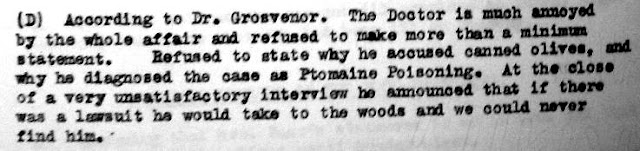
This week, I've been putting the finishing touches on two dissertation chapter drafts! It's been a long haul, and it'll be a longer one yet, but progress is progress. Because this is so on my mind, I figured I'd share a little gem from the archives that didn't actually make it into my Chapter 3, but that is too funny and quirky to ignore entirely. This is from the files of Ernest C. Dickson, who was a Stanford University scientist who worked on behalf of the canning industry in order to help make ripe olives safe from botulism (after a big outbreak of botulism poisonings in 1919-1920). In this document, a California state health official went to investigate a case of poisoning that was allegedly caused by eating canned ripe olives. He talked to the victim and the victim's wife, the grocer, and the doctor who initially diagnosed the illness. The doctor, one Dr. Grosvenor, didn't seem to happy to talk with the state health official: "He would...

Agricultural History Society

Image
So, I've alluded to the Springfield, IL farmer's market a few times this week, in earlier posts. What might have brought me to Springfield, Illinois, the Land of Lincoln, you might ask? Well, it was none other than the 2011 Agricultural History Society meeting! Not only did I get to pose with the whole Lincoln family (and my dear friend HC): But I also got to see the kitchen of the actual Lincoln home, and to learn about how the family might have cooked in the 1850s: But in addition to seeing Lincoln (everywhere in that city!) I also partook in a really cool conference. The program describes it thus: "Contemporary debates about food, agriculture, and rural life are often framed in opposition with little attention to historical context. Proponents of the local, slow, and organic often emphasize quality while advocates of the global, fast, and industrial stress quantity to satisfy world demand for food. The Agricultural History Society addresses this conundrum in...

Stories Inside the Can

Image
Food fascinates me not only in a recreational and personal context, but also in a historical and professional context. Although I haven't spent a lot of time writing about it here (what does that suggest about how I view my work and this blog?!), my dissertation (i.e. my full-time job) is a historical analysis of canned food in twentieth-century America. To begin the tale of why I chose this topic, let me share several photos with you. Take some time to study each one carefully, to think about what kinds of questions and stories emerge from a close look at these compelling artifacts and an attention to their dates and captions. Dolores Harris, daughter of FSA (Farm Security Administration) client George Harris, with canned food prepared by her mother. Dameron, Maryland. August 1940: Mrs. Watkins (project family) in her smokehouse showing canned foods and cured meat. Coffee, Alabama. April 1939: "In a fish cannery, Los Angeles, Cal." From The Chinese in California, ...